
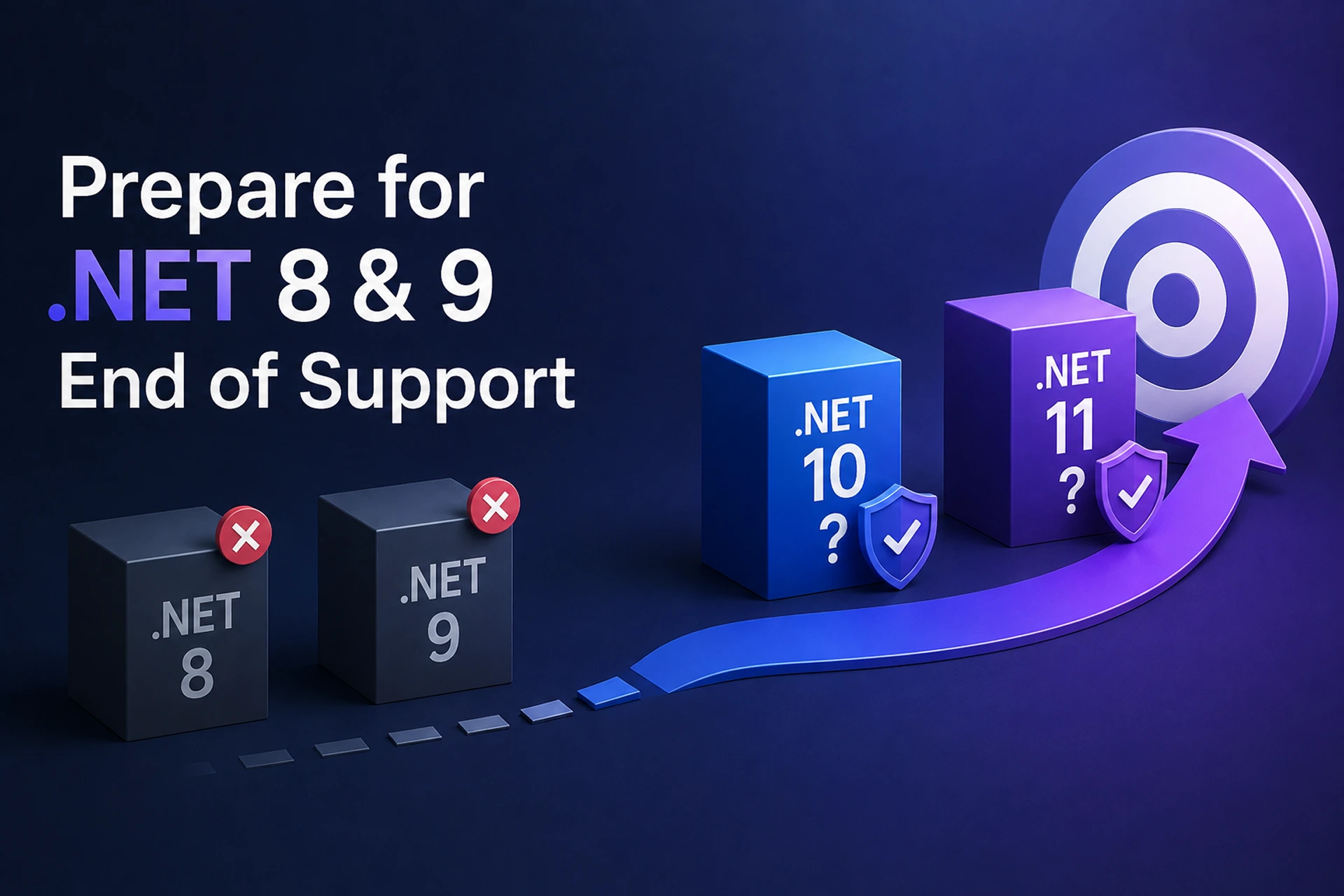
On November 10, 2026, Microsoft ends support for both .NET 8 (LTS) and .NET 9 (STS) on the same day, a rare convergence caused by Microsoft extending Standard Term Support from 18 to 24 months. Your applications won’t stop running, but they’ll stop receiving security patches, bug fixes, and technical support. The safest upgrade path is .NET 10, which secures your environment with LTS support through November 2028. Avoid stalling for .NET 11; even though it drops that same month, it will not be production-ready on day one.
The November 10, 2026 Deadline: Understanding the .NET Lifecycle Convergence
This is unusual as .NET 8 is a Long Term Support (LTS) release with a standard three-year window, while .NET 9 is a Standard Term Support (STS) release that would normally expire on a completely different schedule.
The reason they now collide is because Microsoft extended STS support from 18 months to 24 months. That change means .NET 9, which was released a year after .NET 8, lands on the exact same end-of-support date. Microsoft confirmed this directly on its official .NET blog in a June 29, 2026 announcement.
This deadline is about .NET (formerly .NET Core, the cross-platform, versioned runtime: 5, 6, 7, 8, 9, 10…). It is not about the legacy .NET Framework (4.x), which has a separate lifecycle tied to the Windows OS it ships with. If your team is still running .NET Framework 4.8 apps, this specific deadline doesn’t apply to you, but it’s worth checking which one you’re actually on, since the naming overlap causes real confusion.
| Version | Release Type | Original Release | End of Support |
|---|---|---|---|
| .NET 8 | Long Term Support (LTS) | November 2023 | November 10, 2026 |
| .NET 9 | Standard Term Support (STS) | November 2024 | November 10, 2026 |
| .NET 10 | Long Term Support (LTS) | November 2025 | November 2028 |
| .NET 11 | Standard Term Support (STS) | November 2026 (expected) | November 2028 |
What Happens the Day After Support Ends?
Your applications will not stop running. That’s the most common misconception, and it’s also the most dangerous one, “still works” and “still supported” are not the same thing.
Here’s what actually changes on November 10:
- No new security patches, even for vulnerabilities discovered and actively exploited after that date. Microsoft has indicated it may ship one final servicing update if a critical issue is caught right at the deadline (November 10 happens to fall on a scheduled Patch Tuesday) but that’s a one-time courtesy, not an ongoing safety net.
- No technical support from Microsoft for issues tied to the runtime itself.
- Tooling starts flagging it. A future servicing update for Visual Studio 2022 specifically will mark .NET 8 and .NET 9 components as out of support. Existing installations aren’t removed automatically, but if your team has the “remove out-of-support components” option enabled in the VS installer, they can be cleaned up automatically on the next update. Worth checking that setting now, not in November.
- Third-party ecosystem support erodes. NuGet package maintainers, hosting providers, and enterprise tooling vendors typically stop testing against or supporting end-of-life runtimes within a release cycle or two, which compounds the risk over time even if nothing breaks on day one.
The True Cost of Inaction: Enterprise Risks
Treating an unsupported runtime as “good enough” shifts manageable technical debt into an immediate operational liability.
Security Vulnerabilities and Zero-Day Exposure
Every CVE published against the .NET 8 or 9 runtime after November 10 becomes a permanent, unpatched hole. For applications handling financial data, PII, or high-volume transaction workflows, a runtime-level vulnerability compromises everything built on top of it.
Regulatory Compliance Failures
For organizations governed by HIPAA, SOC 2, or PCI DSS, an “unsupported runtime in production” is an automatic audit failure. These frameworks require active, verifiable patch management as a baseline control. The cost extends beyond fines, it signals a severe operational resilience gap to enterprise customers during vendor risk reviews.
Rising Infrastructure Costs
Older runtimes lack the performance efficiencies built into modern releases, meaning your cloud infrastructure costs will climb relative to competitors who upgrade. Furthermore, stalling the migration makes future modernization efforts exponentially more expensive.
The Migration Path Forward: Why .NET 10 LTS Is the Right Target
.NET 10 shipped as an LTS release in November 2025 and is supported through November 2028. It is the definitive target for enterprise migration.
Cloud Cost Reductions Through Performance Gains
.NET 10 brings genuine efficiency improvements that directly reduce cloud compute costs. These backend efficiencies optimize memory allocation and improve startup times, directly benefiting high-traffic workloads and complex microservices.
Built for Interconnected Architectures
Modern enterprise stacks depend on tightly connected systems, API layers feeding AI agents, robust workflow automations, and high-throughput data integrations. .NET 10 provides the stable, production-tested foundation necessary for demanding enterprise environments.
What If You Can’t Migrate in Time?
If your portfolio is too large to fully migrate before November, you need a contingency plan. These are temporary bridges, not solutions:
- Isolate legacy applications on segmented infrastructure to limit the blast radius.
- Update the underlying server OS to ensure you aren’t compounding risks with end-of-life infrastructure.
- Tighten WAF rules around applications running on unsupported runtimes.
- Formally document the exception for audit purposes, auditors prefer a documented remediation plan over an unacknowledged gap.
For complex portfolios which have tangled dependencies, custom middleware, intricate hybrid architectures, partnering with a dedicated migration expert is critical. A specialized team can stabilize the architecture, minimize business disruption, and execute the .NET 10 transition while your internal teams remain focused on core operations.
A Strategic Action Plan for IT Leaders
- 1.Audit your portfolio: Inventory every microservice, API, and legacy application on .NET 8 or 9. Flag third-party dependencies that could bottleneck the upgrade.
- 2.Update your toolchain: Ensure development teams transition to modern, supported environments before legacy components are automatically flagged.
- 3.Execute the migration: Test cryptographic API integrations (a common breakage point) and run full regression suites before cutover.
- 4.Engage a migration partner: For high-risk portfolios, bringing in external specialists de-risks the timeline and guarantees your compliance posture remains intact.
Frequently Asked Questions
What is the exact end-of-support date for .NET 8 and .NET 9?
The exact end-of-support date for both .NET 8 and .NET 9 is November 10, 2026. Microsoft confirmed this rare convergence in its official .NET blog in June 2026.
Will my applications stop working after the deadline?
No, they will keep running. However, the lack of security patching and technical support immediately increases your vulnerability to cyberattacks and compliance failures.
Should I upgrade to .NET 10 or wait for .NET 11?
Upgrade to .NET 10 now. .NET 11 is a Standard Term Support release with the exact same 2028 expiration date. Waiting gains you no extra support window and sacrifices valuable migration runway.
Does this deadline affect legacy .NET Framework 4.x applications?
No. This specifically applies to modern .NET (versions 8 and 9). The legacy .NET Framework has a separate lifecycle tied to the Windows OS.
Does Microsoft offer extended or paid support for .NET 8 or 9?
No official extended support program exists from Microsoft. Upgrading to .NET 10 is the only officially supported path forward.
Conclusion: The Clock Is Already Running
November 10, 2026 isn’t a soft deadline, it’s the day Microsoft stops patching .NET 8 and .NET 9 for good. Everything above points to the same practical conclusion: the safest, lowest-cost path is to start the move to .NET 10 now, while there’s still enough runway to audit, test, and cut over without a rushed, high-risk sprint in October.
That’s exactly the work we do. Artesian Software Technologies helps enterprise teams migrate off legacy .NET runtimes without disrupting operations. We resolve the complex dependencies, compliance requirements, and API conflicts that stall migrations, ensuring your transition is fast and seamless.
If you already have a migration plan underway, we’ll review it and pressure-test the timeline against November 10. If you haven’t started, we can run a full portfolio audit and hand back a prioritized roadmap.
Either way, the applications that go into November unmigrated are the ones that end up costing the most, in engineering hours, in audit findings, and in incident response. Contact us today for a .NET migration assessment and make sure yours isn’t one of them.